
People behind the progress – Kirsty Given at Clarity Business Travel.
Behind every sustainability strategy are people navigating complexity, data, customer priorities, and long-term change.
In this interview, Kirsty Given reflects on how sustainability has evolved from an internal responsibility into a core part of Clarity’s approach to business travel and meetings. She shares an honest perspective on driving long-term change, responding to customer expectations and embedding responsible decision-making across the organisation – while recognising that meaningful progress is a journey, not a destination.
Tell us a little about your role and what it involves day-to-day. Has sustainability always been part of it, or did it grow over time?
Let me give your readers some context for this one. Before Agiito was acquired by Portman and became part of Clarity Business Travel in 2023, I was part of the Agiito team. I carried my experiences forward as we transitioned into the Clarity.
And if I look back to 2020, I was responsible for facilities, including ISO, and we held ISO 14001 – Environmental Management System (EMS). COVID then gave many of our customers more time to examine non-core business activities, and we started being asked some challenging questions around what we were doing in relation to sustainability. While we were active in the area and assessing our environmental impact, it was more from an internal perspective.
The customers who were asking us the deepest questions were from industries for which published carbon footprint reporting was becoming a must for their procurement teams. It became a natural extension of my existing role. If I’m honest, I didn’t know what I was letting myself in for. My eyes were rapidly opened to the world of sustainability.
So, when and how did you start working with Greengage?
As Agiito, we engaged with Sam Cande, who is now with 360 Consulting by Greengage but was part of her own business back then. Sam and her team of experts helped us create our first carbon footprint report. Clarity was doing the same thing with Greengage at the same time, so we had very similar trajectories, with the customer being at the heart of accelerated progress.
From that point on, sustainability has become increasingly ingrained in every contract and bid, every decision that customers are making in relation to business travel procurement.
Internally, though, we have gone on a massive journey too.
People now understand the wider benefit of what sustainability can bring and that it’s not just about the environment in a carbon footprint report. It goes beyond that into the social elements and the equally important governance side of things.
ESG sounds like a job in itself! Has that changed in recent years?
Five years ago, it was probably ten per cent of my role. I could make it 150% of my role today. And we’re now a team of four, for which sustainability – as part of a responsible business – is our primary focus. It’s become such a huge part of what we do and where we need to go in the future.
We’re planning for Net Zero in 2050, so we’re looking at everything we aim to deliver over the next 5 to 25 years. In terms of what that means my day-to-day looks like, it could be anything from spending the best part of a week in a spreadsheet. I’m looking at data and numbers, trying to fathom things out and make calculations, all while thinking through how we get to that number in 25 years – what’s our plan?
You have a big goal as Clarity – as an organisation! How does that work translate into your client proposition and your customers’ business travel meetings?
My role has historically been internally focused – what is our response as a business, and how are we managing and reporting on our impact. Around a year ago – probably more – we evolved that into what are we doing to support the customer and the customer achieving their goals?! How do we make travel more sustainable?
That internal sustainability focus and knowledge meant it made sense for those questions to start with my team and me. We now have a dedicated sustainability delivery executive at Clarity whose role is purely focused on how we provide customers with everything they need to meet their sustainability objectives for travel and meetings.
Travelling sustainably can sound like an oxymoron. We are really conscious about talking about making travel more sustainable, not making travel sustainable!
There are so many aspects to it, from the data element and how we drive those data-driven decisions and support the customer in doing so. And we’ve got some amazing data analytics from a systems and a people perspective in the business. It goes all the way through to how we help make a simple change within a booking system – so that travellers can make more sustainable choices without it feeling like they need to spend an hour reviewing credentials and hunting the internet themselves.
Like everybody, we’ve got a massive journey to go on, but there are loads of initiatives we’re excited about that are coming soon. We’re just working on where and how they fit into the bigger mix of deliverables.
So your day-to-day is quite varied?
Yes. I may be looking at the bigger strategic picture, but there’s not even a day or week or month that’s the same.
In terms of current priorities, we’ve been working with Sam’s team at Greengage to get our science-based targets ready for external verification. And when you lift the lid on sustainability, it’s not simple -certainly when you’re looking at the carbon side of things.
I suppose if you’re doing it properly, it is complex, right?
Exactly. And then we made the decision, as we set off on our path, to be as open, transparent, and responsible as possible. It involved starting from scratch with a lot of our carbon reporting. Not because we’d been deceptive or secretive up to that point – we’d just learned so much more and were better equipped to take it up a level, as part of a larger company with an international footprint.
Setting our science-based targets is a huge project. We’re trying to put that customer focus on sustainable solutions and making sure we deliver what the customer needs – today and in the future – so they can continue to travel while making that travel as meaningful and purposeful as possible and manage their environmental impact. Engagement with our supply chain will be a huge part of that focus over the next five years.
Social value is huge for us as well. Going back to that customer driver, customers want to know what we’re doing in social value generation. And although fundraising and volunteer days are amazing and we should be doing them, it goes far beyond that now.
As part of customers’ value chains, they ask us detailed questions about how we are generating that value. recording and measuring that is now a significant part of our corporate responsibility strategy. Business continuity and our ISOs are still with me, so we do a lot of internal auditing and maintain our assurance standards.
Alongside the science-based targets – a big one – are there other goals you’re working towards currently?
If we look across the wider Portman Travel group, Greengage has really helped accelerate the Elegant Resorts and If Only travel sustainability journey, with achieving Travelife – a sustainability certification specifically designed for tour operators. That project sits with one of my team, and I thought Ecovadis was complex, but Travelife takes it to an even greater level. They have to be virtually audited and physically audited, and that’s after the huge questionnaire that they’ve spent a year completing.
A lot of what we would have gone to Greengage for five years ago, we now have the in-house knowledge for, and our relationship is such that we can achieve additional value by bringing them in for the really specialist pieces, like specialist consultancy for our SBTi (Science Based Targets initiative) or the Travelife certification.
It’s nice to reflect on that and see how that partnership’s evolved and how we’ve matured in our own internal knowledge and expertise. Greengage, including Sam and her team, have been a great mentor as part of that.
If you’re seeing it a lot more from the customer side and tenders, do you think sustainability will have a bigger influence on travel and events? Or do you think we’ve reached the peak?
I certainly don’t think we’ve hit a ceiling because the changes we need to make to mitigate the risks associated with climate change aren’t going anywhere. I think we will get to a point where a lot of what is seen as USP for some businesses today will just become an expectation as standard.
If you compare the luxury side of the business with business travel, in terms of what’s important to a customer, buying a luxury holiday versus a customer buying business travel, things are very different because business travel customers will always continue – and rightly so – to challenge suppliers on how they’re performing and what they’re doing. They’ll push for that continual improvement. That push helps us drive things forward and prioritise.
Bookers are a big influence on that, too, aren’t they?
Yes. Bookers want to be able to do the right thing, but they don’t want to have to be inconvenienced to do it; it has to be as seamless as possible. It’s just like with any consumer decision – you don’t want something to be to make to be made to feel difficult to do. You just want to be able to make your choices and get on with it.
That’s how we approach the development of customer-facing technology. It should never feel clunky; it has to feel intuitive – built in and served up for people so it doesn’t feel like a chore or an extra job to do. And that’s another fantastic benefit of the partnership with Greengage because we’re integrating ECOsmart for venues and hotels into our own technology. It allows our bookers to make informed choices effectively and seamlessly.
And likewise, although this isn’t powered by Greengage, being able to use the CO2 data of a flight or comparing two flights and being able to use that data intelligently to inform people in a really simplistic way. We’re big on utilising the great data technology that’s out there and bringing it into our own technology, while making sure that we’ve got the right expert connections behind it.
Is that a project that you’re particularly proud of from working on with Greengage or is there a is there like a bigger one?
Personally, the journey we’ve gone on with the transparency of our carbon reporting is huge for me. It’s something we can be really, really proud of. And it sets us up for true planning and reduction going forward. I think from an external perspective, the day that we have ECOsmart fully integrated into ClarityGo and MeetingsPro will be incredible, because within the hotel world, it is so difficult to tell a story, and you need some sort of benchmark.
ECOsmart brings us the opportunity and ability to do that within our own technology, with externally validated certification displayed for our customers, so they can make a more informed choice more easily.
When comparing a flight with another flight, it’s very statistical. With a hotel, it’s so much more emotive because it’s not just a seat on a plane for two hours, five hours. As a traveller, you’re going to experience that for at least 24 hours, and there can be many different factors and choices to make.
Being able to give the booker and the traveller the assurance that that hotel has gone through a rigorous audited certification process, and we’re being transparent about how that hotel is performing, and we’re showing them that, and it is a game-changer for me.
It also allows us to work with procurement managers to evidence their scope 3 supplier engagement. We can show the progression – that they are striving for a wider supply chain that is environmentally driven, that they’re monitoring and measuring the performance from an environmental and sustainability perspective of the hotels that their people are being asked to use.
Scope 3 can be a minefield– there are a lot of indirect emissions that sit within your supply chain that you haven’t got direct control over, and a lot of progress in the short to near term has to be built on encouraging your supply chain to be better and to make progress on tracking and reporting. ECOsmart is a tool that will enable us to show our customers they can prove progression, report on it internally and externally, and drive their ethos through their supply chain.
Is it affecting hotel programmes?
We have just started to see customers adopting ECOsmart as a measurement tool within their hotel programs. It will be very much led by the customer as to what they do with that data and measurement but customers want to show assessment of environmental and social impacts in their supply chain, ECOsmart offers a solution for them to do that to monitor their programme against consistent sustainability criteria.
I do genuinely see it becoming more stringent over time, but it will be 100% customer-led.
If you zoom out of that for a little bit and apply the same principle to the customer bids and tenders that we answer as Clarity, the weighting on sustainability questions is now pass or fail, and we’re seeing customers put carbon clauses into our contracts, with some bids having equal weighting on commercials and sustainability.
There’s a drive to see the science-based target setting – it’s an expectation for the majority of our customers. Some customers are now monitoring, and to a degree mandating, that we’re on that path. We may be a bigger supplier in their supply chain versus a single hotel on their hotel programme, but that principle will continue to flow downstream as we approach.
How do you see sustainability influencing travel and events more broadly?
From a business travel perspective, it’s that balance between cost and sustainability. We now see, as standard practice, sustainability teams coming into procurement conversations, and it absolutely has a seat at the decision-making table. It’s very much driven by a carbon figures and facts perspective.
The leisure market has a different lens when it comes to sustainability, more of a societal impact in terms of the younger generation. The level of personal awareness and education on sustainability means they’re prepared to make tough consumer decisions and walk away from things that they don’t feel resonate with their personal morals. It’s not necessarily the CO2 difference on a one flight to another, which is a big driver from a business travel perspective.
Are you quite committed to it personally? Are you quite a sustainable person?
I try to be, but I think at the same time I am, like all humans, flawed.
I think it’s a gradual process, and for me, it starts with the small things, exercising consumer choice and buying fruit that’s not wrapped in plastic, trying to avoid ‘fast fashion’ although it is hard to do. Saying that, we had solar panels installed on our house about 18 months ago. I’ve just bitten the bullet, and I’m getting an electric car, but that was a really difficult choice for me. I still don’t know which side of the argument I sit on when you consider the embodied carbon and the lithium battery that’s been mined out of the earth Compared to keeping my diesel car running on the car for another 5 years
I understand that everybody is on their own journey of acceptance, and from a work perspective, what I really like to see is that even if one person thinks about one thing differently, the message is getting out there. it is about a personal series of smaller changes. We can’t turn our lives and our businesses upside down overnight.
It has to be a gradual thing, but the clock is ticking!
It certainly is. So, if there was one tip that you could share with others in the industry, one sustainability tip.
Actually, I’ve got three…
You’re well prepared!
Firstly, people will connect with the story and how it makes them feel – that’s what they will remember. They won’t remember you reeling off lots of statistics and carbon footprint reports. Bring it to life for people and make it personal to them.
Secondly, if you don’t know where to start, just start. There are some people who – because they don’t know where to start – won’t change anything at all. Sometimes it feels so massive, it’s paralysing. And you can go from feeling like you’ve got to literally save the planet to ‘how do all these actions that I’ve got to do? How do I contribute towards that?’ You just have to take a breath and keep going. It can feel so massive, and you’ve just got to find out what matters most to the people that matter most to the business.
Ultimately, that’s your own people, finding out what’s going to motivate them and what’s going to engage them with what you’re trying to achieve and what our customers want. It starts there, really, because they’ll become your biggest advocates, your biggest champions. If I were still sitting here on my own, trying to solve all of this, we wouldn’t have got anywhere in the last five years.
My final tip is to be a data hoarder. Collect every bit of data that you possibly can, because the chances are you are going to need it for your carbon reporting (GDPR compliant, of course).
So, what made you partner with Greengage?
It’s the expertise within Greengage and the fact that they understand our industry.
In the beginning, we were probably a little bit rabbit in the headlights with where to start, and we needed someone to explain things and help us take our first steps towards doing the right thing.
Greengage was a very natural fit, and that relationship, over time, has become increasingly ingrained. At the start, they were our consultants, and we were the customer, but now there’s a level of trust – there has to be when someone is digging around in the dirty laundry of your data to work out where all your hidden emissions are.
If we look at what collaboration between you and Greengage the teams looks like in practice, the word collaboration almost feels like an understatement.
Yes, it’s a great relationship if you are prepared to be honest and hold a mirror up to yourself. You can’t bluff your way through it, and you will find things you aren’t doing or could be doing better, and they help with that. It’s got us to a place now where we can have some really open, frank and challenging conversations, but at the same time, we’re both invested in the same things, ultimately, we’re pushing the same rock up the same hill.
It’s got us to the place where we’re able to work with Greengage to grow ECOsmart to benefit our customers and the industry. With sustainability, competitive advantage almost needs to go out the window. On a universal level, this isn’t about making money or bringing something to the market the quickest. It’s about us being able to make the travel industry as sustainable as we can, make sure that people can still travel, but they can do it responsibly, because the social and economic benefits of travel are huge.
And we all want a planet still to live on in however many years to come, and for future generations to thrive.
Our suppliers’ commitment to delivering that is important, too. It’s all about making this as seamless as possible to customers, so the enhancement that ECOsmart brings is fantastic. The icing on the cake is that enhanced data that ECOsmart can deliver both for our customers and us – it really shows that commitment to longer-term sustainability and supply chains.
Having Greengage as a partner and really maximising the expertise that sits within their teams to enhance what we’re doing internally is a huge part of that relationship. Then extending that expertise out to our customers as well is fantastic.
From a personal perspective, I get fulfilment from using that expertise for the real nitty gritty stuff – that longer term trajectory towards net zero and science-based targets.
And continuing that education for our wider business is important as well. It isn’t one person’s problem. It’s corny, and everyone says it, but it’s that all our stakeholders, from our internal people to our suppliers to our customers, to the community around us – we ALL have to be part of the longer-term solution, and Greengage are a key expert partner in this landscape .
You’ve talked a lot about that internal company perspective, and it’s obviously incredibly important to you and to Clarity as a business. So, how do you approach getting and keeping everybody engaged and on board with it internally?
About a year ago, I sat down with Pat, our CEO and said, we’ve got all of these priorities, and we shaped them into a strategy together. So, we have four pillars that we talk about internally and it all comes back to the principle of being good citizens.
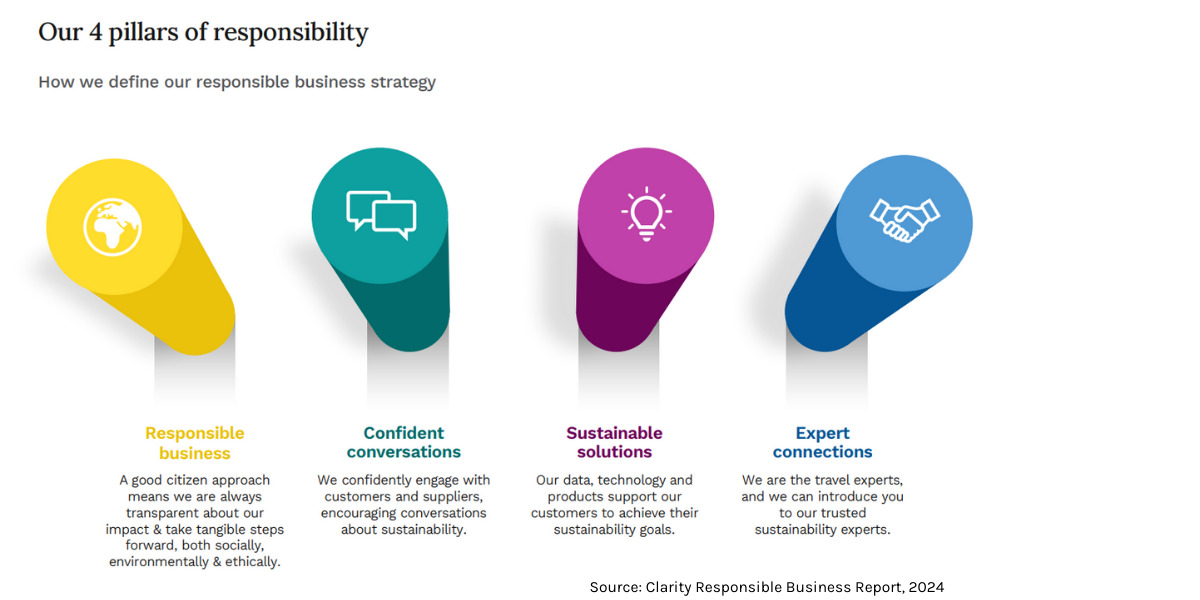
You could summarise our first pillar – responsible business – as people, planet, community and ethical business. The second, another priority area, is confident conversations. Be it internal or external, when we bring sustainability into any and every conversation, we make sure that we can have those conversations confidently, and with sustainable solutions, our third pillar, in mind. We also make sure we deliver sustainability, whether via our tech and or our service delivery, through our expert connections.
Those expert connections are the fourth pillar. It’s really important because we’re business travel experts, and when our solutions need to go beyond that, we acknowledge that we need to partner with the right people to make sure all of the other three pillars progress at the same time. By partnering with people like Thrust Carbon, they’re one of our expert connections for example, it ensures our tech is powered by the best-in-class carbon calculations.
But Greengage are also a major part of that broader network that we’ve got in place. This year, we published our first Responsible Business Report outlining that strategy, because we do some amazing things, but we don’t always tell the story. And we’re not saying that we’re perfect. My goal is to always be as open and transparent as possible about where we’re at and where we need to be next.
But I think telling that story and sharing that with our customers, our suppliers and our people is really key because we can all learn from each other.
We love that approach as well, because there are probably some out there who are too afraid to say they’re still working on it!?
There’s that whole green hushing piece, isn’t there? I don’t think you should ever be afraid to say ‘we know we need to work on this’ or ‘we know this is an area that we need to focus on’.
It’s all still very new to most people and even some of our customers, whose sustainability has been a priority for the last decade – we know we can learn so much from them. We’ve all got a responsibility as part of that supply chain to help others who are maybe just starting or in a similar place to us, but have really excelled in a different area.
We’re naturally a very people-centric business and have been for a long, long time. So the social, community side of our programme is quite evolved. I’m not saying we can’t do more with that, but it has been a natural channel for us to progress and evolve that because we already had some amazing foundations in place.
Whereas you start to look at some of the things that we’ve had to do from scratch, almost, and we’re still on a massive learning trajectory.
We’ve got some amazing people in our broader supply chain who are leading the charge in the areas that we know we need to develop. And for me, it has to be about collaboration for sustainability. How you serve that up is your competitive advantage, but sustainability itself isn’t about individual success. It’s about that fundamental global issue we all need to solve. And no one person, business or even country can solve that in isolation.
With all that in mind, if there was one change that the industry could make to help sustainability move faster as a whole, what do you think that would be (aside from aviation fuel)?
Two things initially spring to mind, and it probably boils down to the same thing – a willingness to share.
Whether that is experience or information/data, and data is an absolutely key part of this, because we all face different challenges, but we all want the same thing.
When we look at our own scope 3 as Clarity, our customer’s travel emissions are our scope 3 category 11, but our customers’ scope 3 category 6 (business travel) and ultimately those emissions are generated by travel, accommodation and events, which is provided by our suppliers. Putting those reduction plans and targets in place for 2030 and 2050 must be driven by data.
It’s a willingness to break some of those data barriers down, but I think we all have to make some sizeable commitments to meet that 2050 Net Zero target together. There’s no shying away from the fact that some of the changes that need to happen, and nothing should stop the intention and progress.
We don’t want people to stop travelling, but we need to make it as climate-friendly and as decarbonised as possible, and every link in that chain from the customer to the TMC to the taxi company that gets them to the airport, to the plane they fly on, to the hotel that they stay in. Everyone needs to be doing their bit in that to decarbonise each section of that, process to get a shared positive outcome.